Starting a water bottling business is an exciting venture, but success depends heavily on choosing the right bottled water production line. bottled water production line The equipment you select will determine your production capacity, product quality, operational efficiency, and ultimately your profitability. This guide walks you through everything you need to know to make smart equipment decisions and build a production line that scales with your business.
Understanding the Stages of a Water Production Line
A complete bottled water production line consists of several interconnected stages, each critical to the final product’s quality and safety. From raw water intake to finished pallets ready for distribution, every step must be designed for efficiency, hygiene, and reliability. Understanding each stage helps you evaluate supplier proposals and identify any gaps in a proposed system.
Stage 1: Water Treatment and Purification
The first stage takes raw water from your source — whether municipal supply, groundwater, or surface water — and processes it to meet drinking water quality standards. This typically involves sediment filtration, activated carbon filtration, reverse osmosis, and final sterilization using UV light or ozonation.
Stage 2: Bottle Blowing or Pre-formed Bottle Supply
If you produce PET bottles in-house, a blow molding machine converts preforms into finished bottles at the required volumes. Some operations source pre-made bottles from suppliers, which reduces capital investment but increases per-unit cost and requires reliable supply logistics.
Stage 3: Filling, Capping, and Sealing
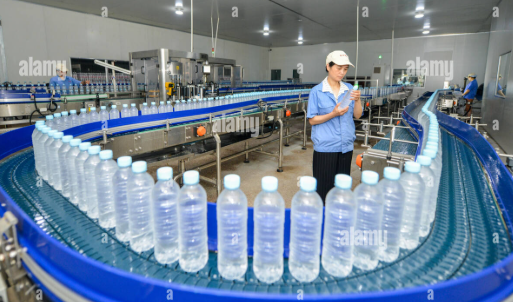
The filling station is the operational core of any water production line. Bottles are conveyed through a rinsing station, filled with treated water to precise volumes, and immediately capped. Modern filling machines achieve fill accuracy to within ±1ml and operate at speeds from a few hundred to tens of thousands of bottles per hour depending on the machine size.
Hygienic Design of Filling Stations
Filling stations must be enclosed and designed to prevent airborne contamination. All product-contact surfaces must be made from food-grade stainless steel or approved plastics. Cleaning-in-place (CIP) systems automate the sanitation of filling valve components without requiring disassembly, saving time and reducing contamination risk.
Cap Application and Tamper Evidence
Modern capping machines apply caps with controlled torque and apply tamper-evident shrink bands or seals in the same operation. Torque verification systems detect incorrectly applied caps and reject them automatically, preventing leakage during distribution.
See also: Accounting Service HK: A Complete Solution for Business Financial Management
Stage 4: Labeling and Packaging
After filling and capping, bottles pass through automated labeling machines that apply pressure-sensitive or heat-shrink labels with brand design, regulatory information, and barcodes. Labeling accuracy and speed must match the output of your filling line to prevent bottlenecks. Downstream packaging equipment wraps bottles in heat-shrink multipacks and loads them onto pallets for storage and distribution.
Label Inspection and Quality Control
Vision systems can be integrated into the labeling line to verify label placement accuracy, check for wrinkled or misaligned labels, and confirm barcode readability. Rejected bottles are automatically diverted from the main line without stopping production.
End-of-Line Palletizing and Stretch Wrapping
Automated palletizers stack multipacks onto pallets in organized patterns optimized for stability and storage density. Stretch wrappers then secure the entire pallet load in plastic film to protect the product during storage and transport.
Choosing the Right Production Capacity
Over-investing in capacity you cannot use immediately ties up capital unnecessarily. Under-investing creates production bottlenecks that prevent you from growing. Calculate your realistic first-year sales volume, then select a production line capable of meeting that demand with room for growth. Many manufacturers offer modular systems that allow capacity expansion by adding filling heads or line segments.
Frequently Asked Questions
Q: How much space is needed for a water production line?
A: A small-scale production line may require as little as 200 to 500 square meters of factory space. Mid-scale operations typically need 1,000 to 3,000 square meters including storage for raw materials and finished goods.
Q: What utilities are required for a water bottling production line?
A: Electricity (3-phase power is typically required), compressed air, and access to source water are the primary utilities. Wastewater disposal must also be planned for.
Q: How long does it take to commission a new bottled water production line?
A: Commission timelines vary from 2 weeks for simple small-scale systems to 3 to 6 months for large integrated facilities with building construction and full equipment installation.
Conclusion
A well-designed bottled water production line is the foundation of a successful water bottling business. By understanding each stage of the process, choosing the right equipment for your scale, and selecting a reliable equipment supplier, you set your business up for long-term success. Invest time in planning, visit reference installations, and choose a supplier who will support you well beyond the initial equipment sale.