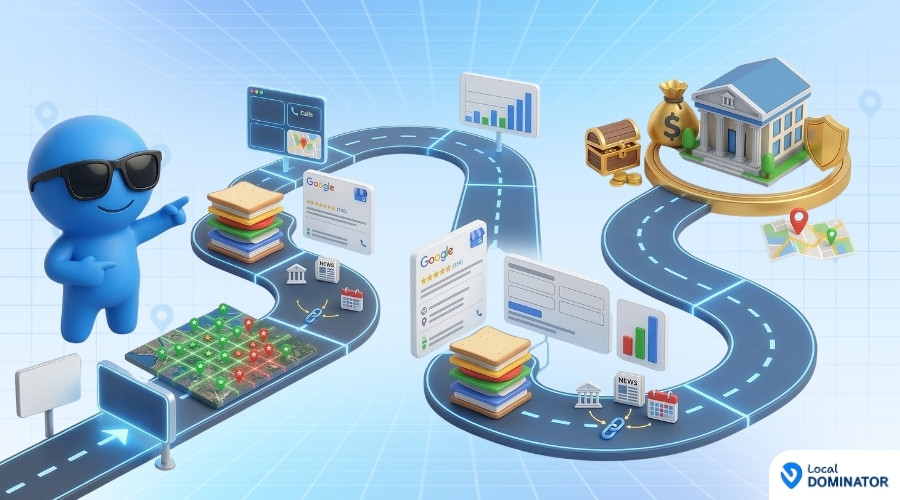
Scaling a local search strategy for multiple clients requires moving from manual execution to automated, repeatable fulfillment processes. Digital marketing agencies must standardize their workflows to manage hundreds of business listings efficiently without increasing labor costs.
As client portfolios expand, manual data entry causes severe operational bottlenecks. Human error frequently leads to inconsistent business information across online directories, damaging client rankings and undermining client trust.
This guide outlines the essential steps your agency must take to build an automated local SEO framework. By implementing these practices, you can scale your operations while delivering reliable, data-driven results.
Why Scaling Matters in Agency Local SEO
Managing a local search strategy manually limits your agency’s growth potential. A scalable framework allows your team to handle larger client portfolios while maintaining high optimization standards.
Key benefits of a scalable framework
- Lowers labor expenses per client account.
- Removes human error from business data distribution.
- Improves client retention rates through consistent performance.
- Increases capacity to onboard multi-location enterprise brands.
- Provides predictable ranking outcomes across diverse business niches.
Core Pillars of an Automated Local Framework
Before scaling your operations, you must establish standard infrastructure. A successful automated framework relies on specific core components to maintain quality control.
List of core pillars
- Centralized business listing management.
- Automated data verification systems.
- Standardized customer review generation protocols.
- Scalable localized landing page deployment.
- Programmatic rank tracking and report delivery.
Modular Component Breakdowns
Centralized Account Intake and Auditing
Agencies must collect accurate client assets before launching any optimization work.
- What it involves: Documenting current login credentials, extracting core business details, and securing brand assets.
- Why it is critical: This process prevents conflicting optimization attempts among your account managers.
Google Business Profile Standardization
Optimizing the primary profile establishes a strong baseline for local maps visibility.
- Focus areas: Primary category selection, operational hours verification, and geo-targeted photo updates.
- Benefits: This step maximizes initial search visibility within the local map pack.
Data Verification and Citation Activation
Publishing correct business information across the web reinforces search engine trust. Agencies often struggle to identify where a client’s business information is missing or incorrect before deployment.
- What it involves: Utilizing a citations builder to scan online footprints, identify missing visibility, and transition data into active directories.
- Why it matters: This tool generates a visibility preview by comparing current web mentions against the official Google Business Profile. It flags incorrect data and updates active listings to ensure consistency across the internet.
Hyper-Local Content Systems
Creating localized content helps clients capture search traffic outside their immediate physical vicinity.
- Focus areas: Building location-specific neighborhood guides and embedding schema markup on landing pages.
- Benefits: This strategy captures long-tail search terms from nearby geographic areas.
Programmatic Review Acquisition
Continuous customer feedback is a major ranking signal that agencies must automate to remain competitive.
- What it involves: Setting up automated SMS and email communication loops for client customers.
- Why it matters: This system feeds fresh behavioral signals to search algorithms while buffering against negative feedback.
Multi-Client Performance Analytics
Scalable agencies cannot waste hours manually compiling individual monthly reports.
- Focus areas: Consolidating campaign metrics, tracking automatic rank movements, and reading citation health graphs.
- Benefits: This approach reduces reporting labor from hours to minutes per client.
See also: How Technology Is Reshaping Careers
How to Select the Right Automation Utilities
Choosing the right tools determines how smoothly your agency can scale operations. Evaluate software options based on specific performance standards.
Factors to consider
- Direct API integration with major local search directories.
- Dashboard simplicity for internal account managers.
- Cost efficiency regarding campaign credit consumption.
- Accuracy of automated error detection mechanisms.
Common Scalability Mistakes to Avoid
Many agencies make avoidable operational mistakes when scaling their local operations.
Avoid the following
- Relying on manual data entry for large client portfolios.
- Skipping the initial data verification and audit phase.
- Allowing mismatched business names, addresses, or phone numbers to persist online.
- Scaling client sales campaigns before securing fulfillment software.
Steps to Grow Your Agency After Systemization
Once fulfillment is automated, your agency can shift its focus from daily operations to expansion.
Steps to grow
- Shift staff resources from manual data entry to high-tier sales strategy.
- Package automated citation monitoring into monthly client retention retainers.
- Offer white-labeled dashboard access to enterprise clients.
- Target marketing campaigns toward multi-location franchise brands.
Future Trends in Agency Local SEO
The local search industry changes quickly as search engine behavior evolves.
Key trends
- Shifting from traditional maps tracking to unified AI search footprint monitoring.
- Increased reliance on single sources of truth for business data.
- Higher platform scrutiny regarding the legitimacy of physical business locations.
- Expansion of local search optimizations to alternative navigation applications.
Final Thoughts
Sustained agency growth depends on moving away from manual operational tasks. Implementing structured software workflows allows your team to deliver consistent client results without increasing internal overhead.
To achieve this level of efficiency, agencies must centralize their technical workflows. Local Dominator is a cloud-based Search Everywhere Platform specializing in unified local SEO and AI search tracking for local agencies and businesses. It serves as a single source of truth that integrates SERP analytics and citations to make visibility simple, predictable, and scalable across all digital touchpoints.