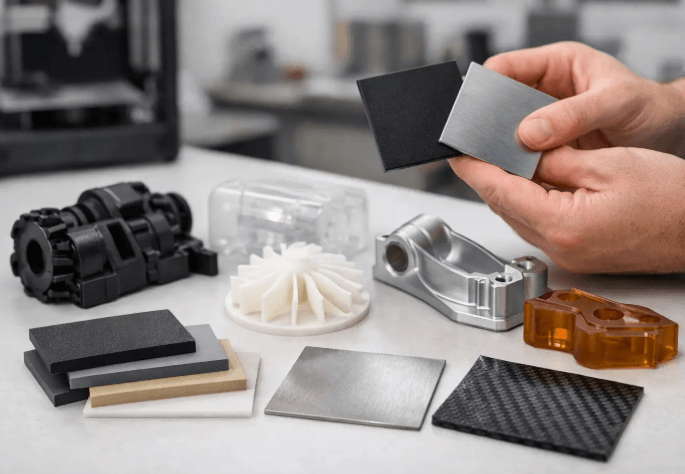
A prototype is often where confidence meets reality. A material that looked perfect in a datasheet can behave differently once it is machined, coated, assembled, heated, bent, or subjected to repeated use. For this reason, engineering teams increasingly treat validation as an ongoing part of product development rather than a final box to check before manufacturing.
The process is especially important when several materials appear suitable on paper. Cost, weight, corrosion resistance, manufacturability, and surface protection may all point in different directions. Testing gives teams evidence that helps balance those trade-offs and choose a combination that performs reliably in the finished product.
Start With the Failure You Need to Prevent
Good validation begins with a practical question: what kind of failure would be unacceptable in service? The answer may be permanent deformation, cracking, excessive wear, loss of coating adhesion, fastener loosening, or fatigue after repeated loading. Defining the likely failure mode helps engineers choose a test that produces relevant information instead of collecting data for its own sake.
This is also where operating conditions matter. A component used indoors at a stable temperature should not be tested exactly like a part exposed to vibration, weather, thermal cycling, and frequent load changes.
Build a Test Plan Around Real Decisions
A useful test plan links each measurement to a decision. Tensile strength may help compare base materials, hardness may indicate resistance to indentation or wear, and fatigue testing may reveal how long a part can tolerate repeated stress. For coated components, engineers may also need to understand whether the surface layer remains attached while the underlying material flexes.
At this stage, sample preparation deserves as much attention as the test itself. Surface finish, coating thickness, curing time, specimen dimensions, and machining direction can all influence the result. Consistency allows teams to compare one material or process against another with confidence.
Use Mechanical Data to Narrow the Options
Once early prototypes are available, Mechanical testing can help eliminate weak candidates before money is committed to full-scale tooling or production. Instead of relying only on supplier specifications, engineers can evaluate samples that represent the actual manufacturing process and intended geometry.
This is particularly useful when a coating or treatment changes the behavior of a component. A surface layer may improve corrosion resistance but introduce brittleness, residual stress, or adhesion concerns. Testing the complete system can reveal interactions that are not obvious when the substrate and coating are considered separately.
Why Repeated Loads Deserve Special Attention
Many products fail after thousands or millions of modest load cycles rather than one extreme overload. Hinges, brackets, rotating equipment, transportation components, and aerospace structures all experience this type of service. Repeated loading can slowly initiate cracks, especially at edges, holes, surface defects, or interfaces between different materials.
By examining fatigue behavior early, teams can adjust geometry, change a coating, improve surface preparation, or select a different material before those changes become expensive.
Production Validation Should Not Be the End
After a design enters production, test data remains useful. It can support incoming inspection, supplier qualification, process control, and investigation of field returns. If a manufacturing change is introduced, engineers can compare new test results with the original baseline to confirm that performance has not been compromised.
See also: Accounting Service HK: A Complete Solution for Business Financial Management
Evidence Makes Engineering Trade-Offs Easier
Another advantage of early validation is that it helps separate material problems from manufacturing problems. If several specimens made from the same alloy perform differently, the cause may be machining, heat treatment, coating preparation, or assembly rather than the raw material itself. Engineers can then design follow-up comparisons that change one variable at a time. This disciplined approach prevents teams from replacing an otherwise suitable material when the real weakness lies in the process. It also creates a stronger technical record for future projects, because successful parameters can be reused instead of rediscovered through trial and error.
Validation also benefits communication between design, procurement, and production teams. When everyone works from the same measured performance data, supplier discussions become more specific and design reviews become less dependent on assumptions. A documented baseline can also simplify future substitutions, because any proposed material or process can be compared against known results before it is approved for routine production.
No material is ideal in every category. The practical goal is to choose the option that best matches the product’s priorities and risks. Structured validation makes those compromises visible. Instead of debating based on assumptions, teams can compare measurable performance and make decisions that are easier to defend, repeat, and improve in future designs.